Training chair dimensions are easy to overlook when products are selected from photographs or catalogues. A chair may look compact but require considerably more room once armrests, writing tablets, casters or storage racks are included.For project buyers, the important measurements are not limited to overall width, depth and height. Seat height, usable seat width, tablet size, occupied depth, stacking space and packing dimensions can all affect the final decision.This guide explains how to read training chair dimensions and use them when planning classrooms, seminar rooms, corporate training centers and flexible commercial spaces.

Why Training Chair Dimensions Matter
The correct chair dimensions affect user comfort, room capacity, storage and shipping.A difference of 50 mm may not seem important when reviewing one chair. Across a row of ten chairs, however, that difference becomes 500 mm. For a project with several rows, it can affect aisle space, seating capacity and the overall room layout.Seat height and seat depth also influence how a person sits. A seat that is too high may leave shorter users without comfortable foot support. A seat that is too deep can prevent users from sitting against the backrest.Armrests and writing tablets affect entry space as well. A chair may have a comfortable seat but still feel restrictive if the arms or tablet are positioned too close to the user.
How to Read Training Chair Dimensions
Most manufacturers list chair dimensions in this order:
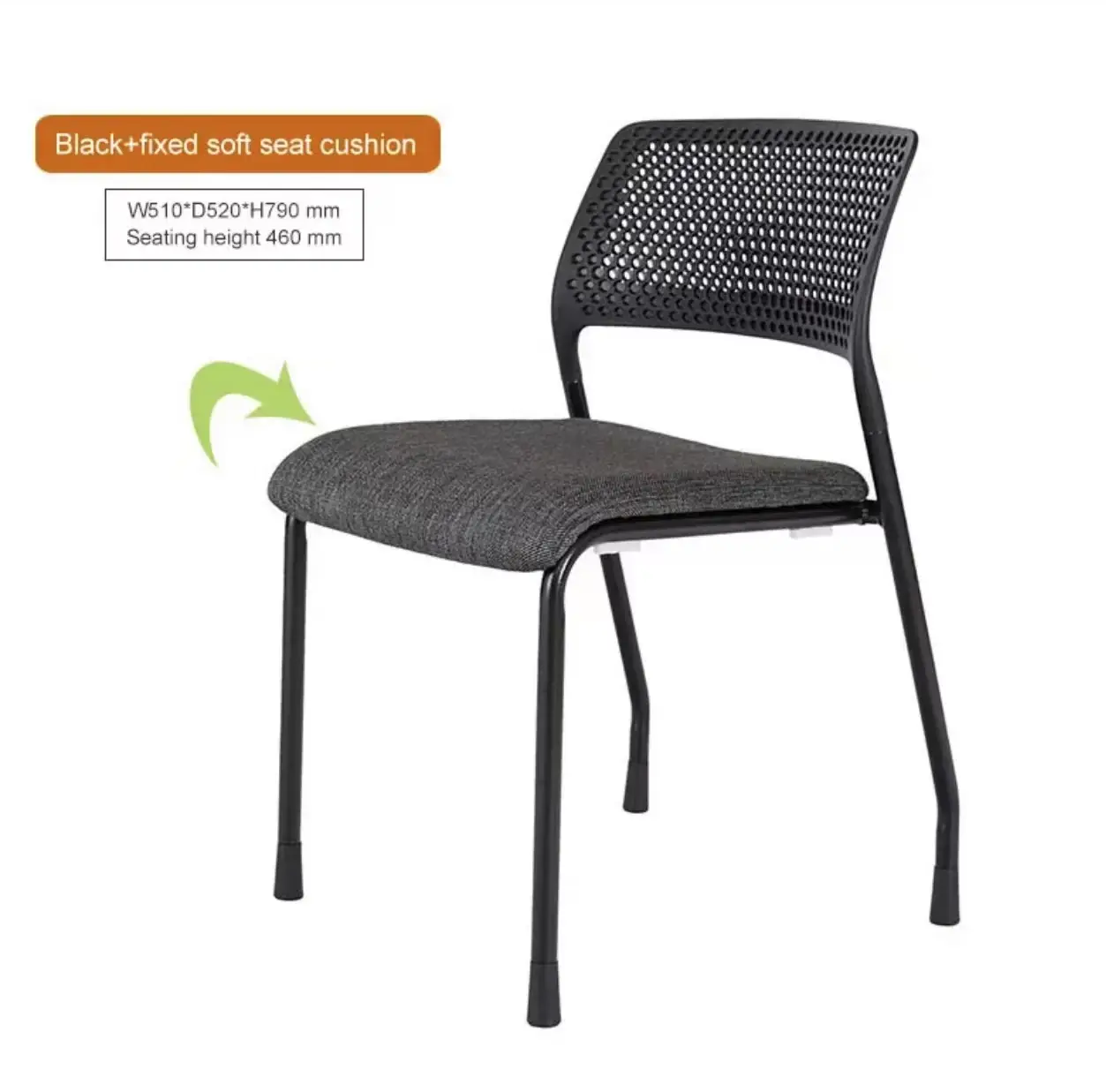
Width × Depth × HeightFor example, a chair listed as
510 × 520 × 790 mm normally has:
- An overall width of 510 mm
- An overall depth of 520 mm
- An overall height of 790 mm
Do not assume every supplier uses the same order. The product drawing or specification sheet should identify each measurement clearly.The official
ISO 24496 office chair standard describes methods for determining chair dimensions. However, it does not establish one required size for every chair. The correct dimensions still depend on the product, user group and intended application.
Overall Chair Width
Overall width is measured across the widest part of the chair.Depending on the design, this may include:
- Seat shell
- Armrests
- Writing tablet
- Side frame
- Caster base
- Carrying handles
An armless stackable chair may be approximately 470 to 510 mm wide. A training chair with armrests or a writing tablet may reach approximately 600 mm in overall width.The writing tablet may extend beyond the chair frame when opened. Buyers should therefore ask whether the published width shows the tablet in its open, closed or removed position.Armrests and frame components may also reduce the usable seating space. When comparing products, ask for both:
- Overall chair width
- Usable seat width
This is especially important for chairs with integrated arms, side frames or writing tablets.
Overall Depth and Height
Overall depth is measured from the frontmost point to the backmost point of the chair.For a basic four-leg chair, the frame and backrest usually determine the overall depth. Folding chairs, mobile chairs and chairs with storage racks may require more space.The listed depth should not be treated as the final row spacing. When someone sits down, their knees, feet and personal belongings extend beyond the chair footprint.Overall height is measured from the floor to the highest point of the backrest. It helps buyers compare the visual scale of different chairs and plan storage, packaging, lift access and doorway clearance.Overall height does not show whether the backrest is comfortable. Backrest shape, usable support area and lumbar position should be reviewed separately.
Training Chair Seat Height
Seat height is measured from the finished floor to the top of the seat surface.Several standard-height HAKKAS training chairs use a seat height of approximately
460 mm, including the
YB4 stackable training chair and the
YB4-F training chair with arms.Upholstered seats may compress slightly when occupied, so the listed seat height and effective occupied height may differ.Seat height must also coordinate with the selected table or writing surface. A chair designed for a standard training table will not normally suit a bar-height table or high counter.When comparing models, ask the supplier to confirm:
- Seat height
- Usable seat width
- Seat depth
- Width between armrests
- Backrest height above the seat
Training Chair With Tablet Dimensions
A training chair with a writing tablet needs more detailed measurements than a basic four-leg chair.Ask the supplier to confirm:
- Usable tablet width
- Usable tablet depth
- Tablet thickness
- Height from the floor
- Height above the seat
- Open position
- Closed position
- Rotation range
- Left-handed availability
- Maximum recommended load
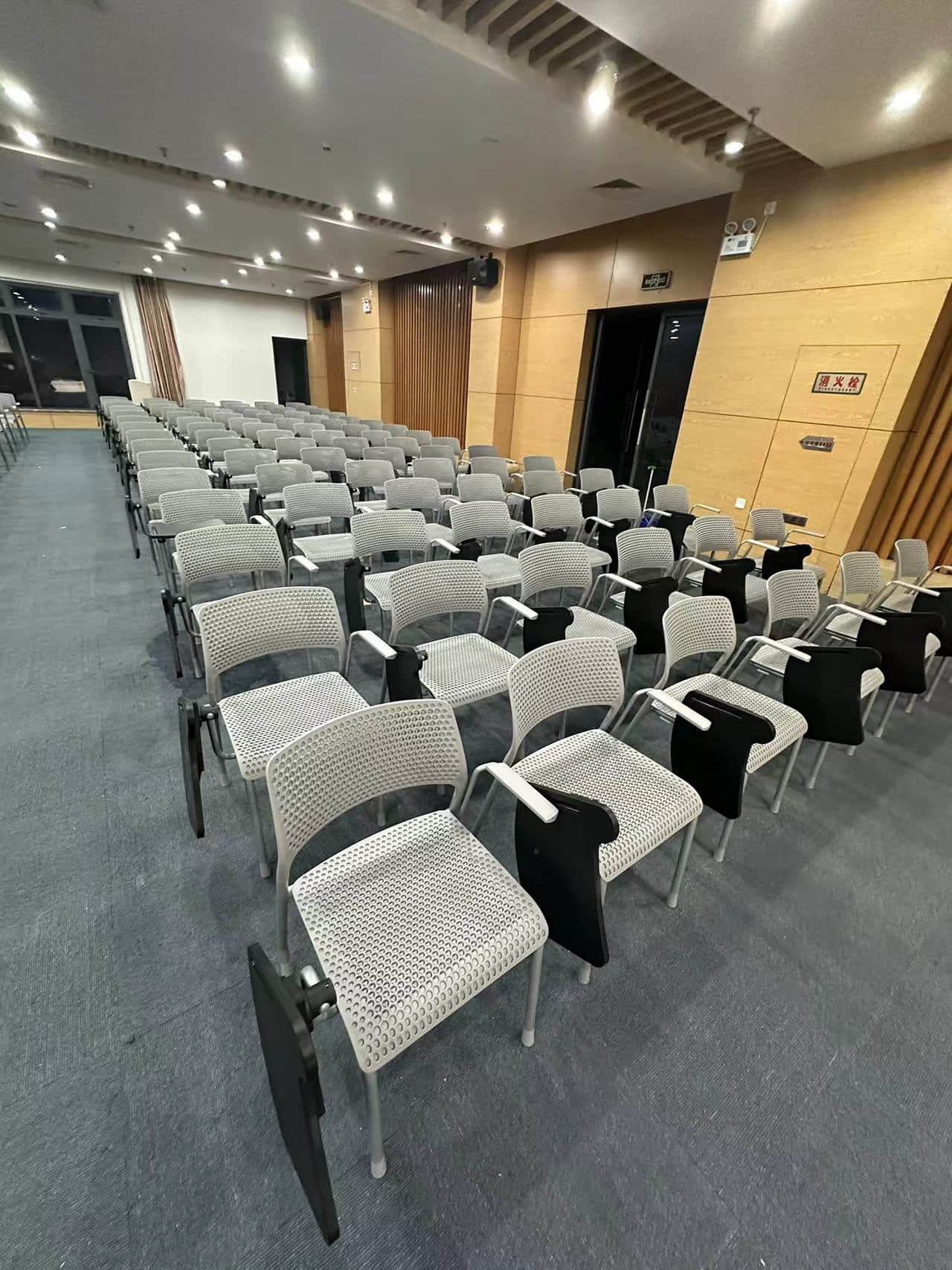
A small tablet may be suitable for a notebook but not for a laptop. The intended use should therefore be defined before the chair is selected.The open tablet may also increase the working width of the chair. This additional width must be considered when planning rows, aisles and spacing between users.
Examples From the HAKKAS Training Chair Range
There is no single universal training chair size. The following examples show how training chair dimensions change according to the chair structure and included features.
H333 Compact Stackable Training Chair
The
HAKKAS H333 stackable training chair measures
470 × 540 × 790 mm.Its relatively narrow overall width makes it suitable for classrooms, seminar rooms, meeting spaces and other projects where efficient seating capacity is important.
YB4 Stackable Training Chair
The
HAKKAS YB4 stackable training chair measures
510 × 520 × 790 mm.Its listed seat height is
460 mm.This model is suitable for training rooms and classrooms that need a simple four-leg chair with stackable storage.
YB4-F Training Chair With Arms
The
HAKKAS YB4-F training chair measures
600 × 520 × 790 mm.Its listed seat height is
460 mm.The additional overall width comes from the armrest structure. When room capacity is calculated, the complete 600 mm width should be used rather than the seat width alone.
YB4-X Training Chair With Writing Tablet
The
HAKKAS YB4-X training chair measures
600 × 520 × 790 mm.Its listed seat height is
460 mm.For project planning, the product size should be reviewed together with the tablet dimensions and the total width when the tablet is open.Product dimensions can be updated as specifications develop. Always confirm the latest technical drawing before sample approval or bulk production.
Planning Room Capacity
A common mistake is multiplying room width by chair width and treating the result as the final seating capacity.For example, ten chairs that are each 500 mm wide have a combined product width of 5,000 mm. That does not mean they will fit comfortably inside a room that is exactly 5,000 mm wide.The layout must also allow for:
- Gaps between users
- Side aisles
- Central aisles
- Entrances and emergency exits
- Door swings
- Trainer space
- Presentation equipment
- Accessible seating positions
- Writing tablets in the open position
- Bags and personal items
Training chair dimensions should therefore be reviewed together with the complete room layout.For projects in the United States, the
U.S. Access Board specifies a minimum clear floor space of 760 × 1220 mm in relevant accessible situations. Requirements vary by country and project type, so the final layout must be checked against local accessibility, building and fire regulations.
Row Spacing and Occupied Depth
Chair depth alone does not determine row spacing.A chair may be 520 mm deep when empty, but an occupied chair requires additional space for the user’s knees, feet and movement. The chair may also move backward when the user sits down or stands up.When planning rows, consider:
- Unoccupied chair depth
- Occupied user depth
- Space needed to stand up
- Passage behind occupied chairs
- Writing tablet position
- Table depth
- Caster movement
- Local aisle requirements
The most reliable method is to test a full-size chair and table sample inside a marked room layout.If a physical sample is not available, request a dimensioned drawing showing the chair in both occupied and unoccupied positions.

Stacking, Folding and Packing Size
Individual product dimensions do not show the complete storage requirement.For a stackable chair, ask for:
- Maximum recommended stacking quantity
- Complete stack width
- Complete stack depth
- Complete stack height
- Weight of the full stack
- Chair trolley dimensions
- Maximum trolley capacity
For a folding or nesting chair, ask for:
- Open dimensions
- Folded dimensions
- Nesting pitch
- Maximum nested quantity
- Total storage length
- Trolley dimensions
Nesting pitch describes how much additional space each chair adds when several folded chairs are placed together. A small difference can have a significant effect when 20 or 30 chairs are stored in one line.Packing dimensions must also be checked separately. Product size describes the assembled chair, while packing size describes the export carton or package.For example, the YB4 chair measures
510 × 520 × 790 mm, while one available export packing specification is approximately
970 × 670 × 520 mm, with several chairs packed in one carton.Before ordering, request:
- Carton dimensions
- Units per carton
- Gross weight
- Net weight
- Total CBM
- Knock-down or assembled packing
- Container loading quantity
- Pallet requirements
Do not calculate freight volume from assembled chair dimensions alone.
Buyer’s Measurement Checklist
Before approving a training chair, confirm:
- Overall width
- Overall depth
- Overall height
- Usable seat width
- Seat depth
- Seat height
- Backrest dimensions
- Armrest height
- Writing tablet dimensions
- Width with the tablet open
- Caster or base footprint
- Folded dimensions
- Stacked dimensions
- Trolley dimensions
- Packing dimensions
- Units per carton
- Product weight
- Carton gross weight
- Table compatibility
- Final room capacity
If a measurement is important to the project, it should appear on the confirmed specification sheet rather than only in an email conversation.
Before You Approve the Order
A physical sample helps the project team check details that are difficult to judge from photographs or drawings.During sample approval, review:
- Sitting comfort
- Seat height
- Seat width
- Back support
- Entry space
- Armrest position
- Writing tablet size
- Tablet stability
- Table compatibility
- Stacking or folding
- Floor protection
- Surface finish
Measure the sample and compare it with the approved drawing. If the product is changed after sample approval, request an updated specification before bulk production begins.HAKKAS is a
commercial seating manufacturer in China supplying training chairs, folding chairs, stackable chairs and training tables for schools, offices and commercial projects.View the complete
training chair collection or
contact HAKKAS for product dimensions and bulk-order support.
Frequently Asked Questions
What are typical training chair dimensions?
Selected standard HAKKAS training chairs range from approximately 470 to 600 mm in overall width, 520 to 540 mm in depth and around 790 mm in overall height. Folding chairs and other frame types may be deeper or taller.
What is a common training chair seat height?
Several standard-height HAKKAS training chairs use a seat height of approximately 460 mm. Bar-height and adjustable chairs use different seat heights and should be matched to the intended table.
How wide is a training chair with armrests?
A training chair with integrated armrests may be around 600 mm wide, depending on the frame. An armless stackable chair may be closer to 470–510 mm wide.
Does the listed width include the writing tablet?
Not always. Buyers should ask whether the published width shows the writing tablet open, closed or removed. The open tablet may increase the working width of the chair.
Are training chair dimensions standardized?
Measurement methods may be standardized, but there is no single mandatory size for every training chair. Dimensions vary according to chair type, user group, armrests, writing surface, mobility and application.